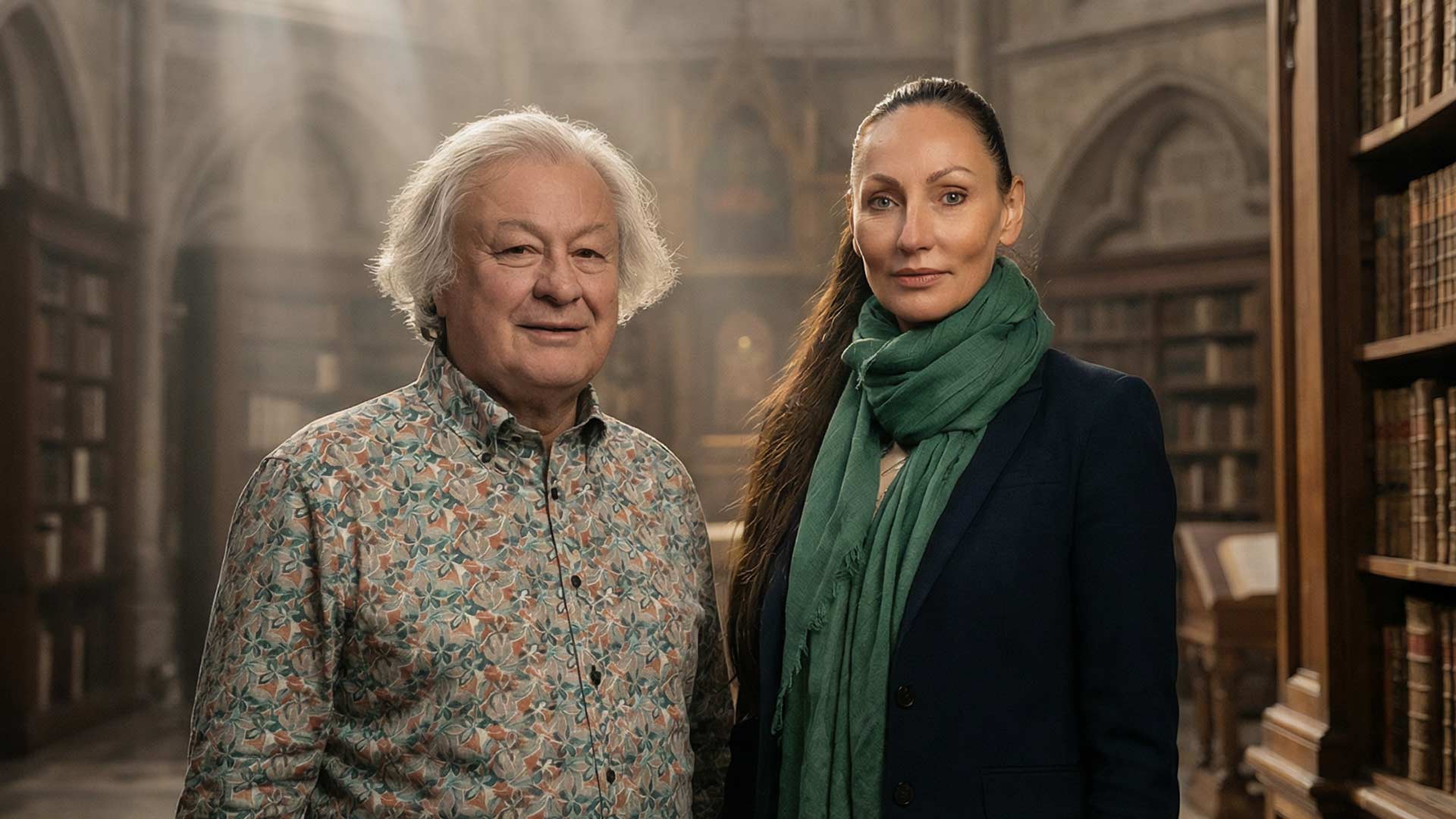
Prof. Dr. Paul Imhof on faith, freedom and the crisis of our time
Do humans need faith – or is reason enough?
Is unbelief really the opposite of faith – or just another form of it?
The conversation with Prof. Dr. Paul Imhof is not about religious slogans, but about fundamental questions of human existence: freedom, relationships, truth and responsibility. The philosopher and theologian talks about his own path between doubt and enlightenment, about the temptation of self-optimisation – and about why it is not a lack of structures, but rather the „non-recognition of the spirit“ that has become the real crisis of our society.
An interview about credibility, humility and the question of whom – or what – we give our hearts to.
Professor Imhof, a fundamental question: In your opinion, do humans need faith – or would a society without faith be conceivable?
Almost anything is conceivable, but the fact is that there are people who believe in God. However, believing does not mean having to accept as true as many incomprehensible things as possible. That is why I distinguish between faith and misbelief and superstition. Anyone who always says „yes, but, but, but“ in interpersonal relationships is only drawing attention to an unfree, failed relationship.
Many people today say of themselves, „I don’t believe.“ Would you agree that this „not believing“ is also a form of belief – namely, belief in something else?
Provocative answer: I believe people’s beliefs and, if necessary, their disbelief. Why? Because I am a humanist. To believe is credo in Latin, which comes from cor-do, meaning: I give my heart. I do not consider anyone to be heartless. But of course, some people attach their hearts to something that later proves to be untrue or not credible.
If we accept that human beings always believe in something, do we then need a framework for belief – moral, social or spiritual? And who or what defines this framework?
In terms of communication theory, it is not enough to simply believe in something. If you do, you are essentially behaving below the level of your own freedom. We are people. In interpersonal relationships, I believe in someone, not just in something. I consider a framework to be superfluous for me. However, a good community of faith is a valuable asset.
You have been dealing with questions of faith both academically and personally for many years: What has your own journey of faith been like? Have there been breaks, doubts, perhaps even a conscious turning away – and what has ultimately shaped you?
Yes, I have a doctorate in philosophy and theology and currently lecture at various universities and colleges. I also head the Christocentric Teaching Centre at St Paul’s Academy. Of course, I am familiar with the world of doubt. I appreciate Nietzsche and Feuerbach. I lived as a monk for a long time and am now blessed with four daughters and five grandchildren. I am also married to Stephanie Imhof. This did not all happen without breaks and fractures. However,
thanks to an enlightening experience many years ago, there is great continuity and not just discontinuity in my life.
In an age of individualism and self-optimisation: What role can or should God still play today – not in an abstract sense, but in very concrete terms in a person’s life?
Individualism is selfishness. Why? To quote Thomas Aquinas, who was influenced by Aristotle: Individuum est indivisum in se et divisum ab omne alio, i.e. an individual is undivided in itself and separate from everything else. How can self-sacrifice and acceptance of another in love succeed?
And now to self-optimisation. Here and there, the church windows still bear the letters D.O.M. For God, the Best, Optimo, and the Greatest, Maximo. As soon as people put themselves in God’s place, the stress of becoming like God begins, in short, megalomania, often with terrible consequences for their fellow human beings. What is good for your body, your soul, and your spirit? That is worth doing. And that is more than enough. No one has to be the best.
And on a more personal note: What does Jesus Christ mean to you personally – intellectually, spiritually and in your everyday life? Has this relationship changed over the course of your life?
I believe in Jesus Christ. He and his message are credible to me. His spirit, the Holy Spirit, continues to work. That is why I study the life of Jesus Christ and his historical impact. As an honorary pastor, I listen to what people tell me and say. I preach, give lectures, write books, baptise, marry and bury. This is my everyday life.
In living relationships, you always learn something new, which means that they change. Christians are not better people than others, but live in an additional relationship with Jesus Christ.
Finally, with regard to the present: When you look at our society – crises, polarisation, disorientation what do you think we are lacking most: faith, trust or humility?
The question reminds me of my interview with 103-year-old Mr Pickert in Borchem. What is the greatest hardship in Germany? I asked Rudolf Steiner’s friend 20 years ago. He did not answer. I asked the same question again. Then he had an inspiration and answered clearly and emphatically: The non-recognition of the spirit! That is where the decline in values begins.
The spirits must be distinguished. Whose spiritual child is someone? The Hebrew word Ämäth means truth, trust and faith. The word Emunah is the intensive form, from which our English word Amen comes. True is what is right. The Emmaus story not only explains the meaning of Holy Scripture, but also tells how one can find peace on earth. The long text can be found in the Gospel of Luke, chapter 24.