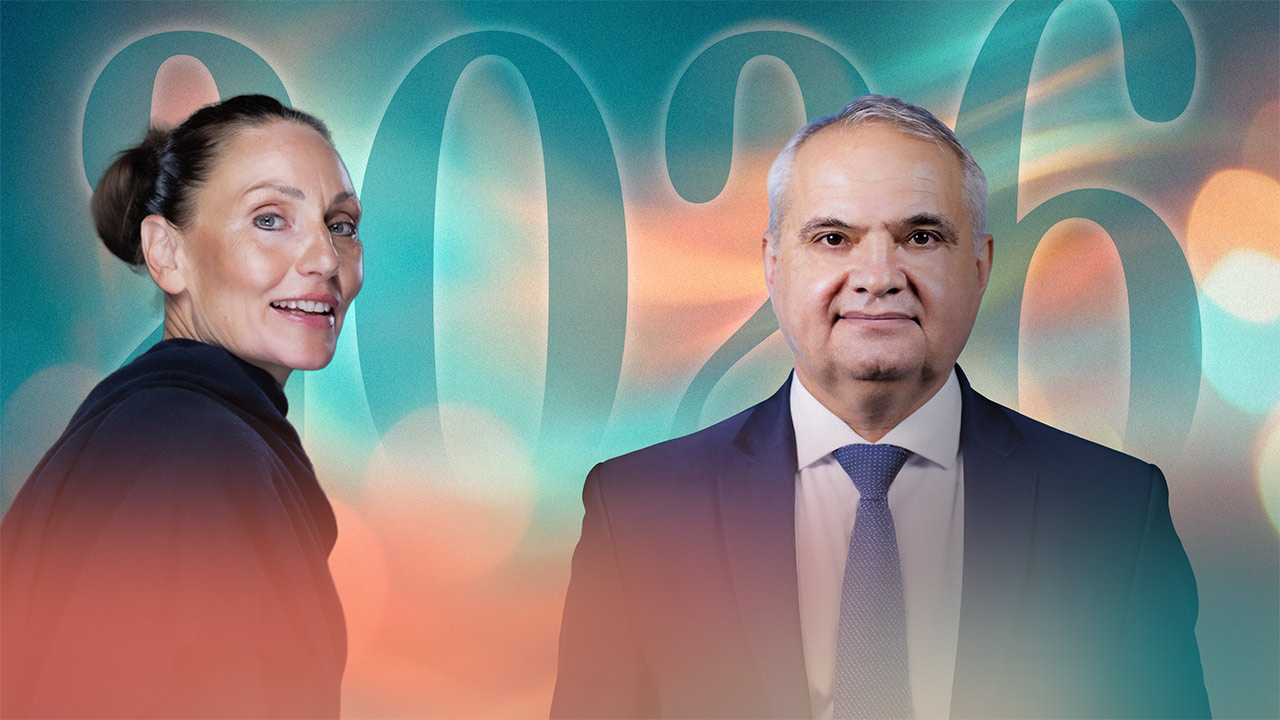
An interview conducted by Sandra Bünger, journalist and Vice-President of WAVe, with President Waldemar Herdt.
- Dear Mr President, in times of war, growing uncertainty, social division, economic pressure and an almost unmanageable flow of information, what do you think people are lacking most at their core? And why do many of the political, media and technical responses fall short on this very point?
What people are lacking at their core is inner orientation. Not information – we have too much of that – but a sense of place: Who am I? What am I responsible for? What gives me stability when external systems falter?
Many of the answers of our time remain superficial. Politics tries to manage, the media tries to explain, technology tries to optimise. But the real vacuum is a spiritual one. When people no longer have an inner compass, any external solution becomes fragile. This gives rise to fear, aggression or withdrawal.
We have learned to repair systems, but we have forgotten to empower people. That is precisely where the gap lies – and it cannot be closed with algorithms or regulations. - Today, peace is often understood as a political goal or diplomatic achievement. However, you speak of a deeper peace. What distinguishes genuine peace from the mere absence of war – and why do so many peace processes fail at precisely this point?
Genuine peace does not begin at the negotiating table, but within people themselves. The mere absence of war is a state, not peace. Peace arises where people are no longer fighting internally – against others, against systems, against themselves.
Many peace processes fail because they treat symptoms, not causes. Treaties regulate interests, but they do not heal wounded identities, historical pain or fear of the other.
Without truth, without acknowledgement of guilt, without a willingness to change one's inner self, peace remains a fragile construct. Stable peace needs moral substance – otherwise it is just a pause between conflicts. - The term "international understanding" is often used, but at the same time it seems empty or ritualised. In your opinion, what is needed to ensure that understanding between cultures and nations does not end at conferences, but finds its way into people's thoughts, actions and feelings?
International understanding fails when it is only thought of in organisational terms. True understanding does not begin with political elites, but with the recognition of the dignity of others – regardless of their origin, history or worldview.
It requires genuine interest, not strategic curiosity. Listening without immediately wanting to judge. And the courage to accept differences instead of levelling them out. We know
from Eastern Europe that mistrust does not disappear through words, but through reliable action over time. Understanding grows slowly – but it is possible if it is based on truth and respect, not ideology. - Traditional values are often suspected of hindering progress. At the same time, we are experiencing a lack of direction and social division. In your opinion, what role do traditional values really play – as a brake or as a foundation for a healthy future?
Traditional values are not the opposite of progress, but rather a prerequisite for it. Without values, there is no direction, only movement. Progress without a foundation becomes an end in itself – fast, but disoriented.
Values such as responsibility, family, loyalty, moderation and respect have sustained generations because they give people stability. They do not protect against change, but against arbitrariness.
Societies do not disintegrate because they have too many values, but because they no longer share any common ones. Traditional values are not a step backwards – they are an anchor in turbulent times. - Freedom of expression is one of the major buzzwords of our time – and at the same time one of the most contested. Where does genuine freedom of expression end for you, and where does manipulation, fear-mongering or moral pressure begin? And what effect does this have on society in the long term?
Freedom of expression ends where fear begins. Not where someone disagrees – but where people remain silent because they fear the consequences.
Manipulation arises not only from lies, but also from one-sided narratives, moral labelling and social pressure. When deviation is sanctioned, freedom is already damaged – even without formal censorship.
In the long term, this destroys trust. People withdraw inwardly, speaking only in protected spaces or not at all. A society that fears free thinking loses its intellectual substance. - Faith is often privatised or portrayed as divisive in public discourse. You take a different approach. What power do you believe lies in faith – not as dogma, but as a unifying element for community, responsibility and humanity?
Faith is not an ideology, but an inner attitude. It reminds people that they are not the measure of all things – and that is precisely where its liberating power lies.
Faith connects because it teaches humility. Responsibility before God leads to responsibility towards our fellow human beings. Where faith is lived authentically, community arises not from coercion, but from compassion and a sense of duty.
In many cultures, faith is less theory than practice. It provides support in crises and orientation in times when external certainties break down. - When we bring all these topics together – peace, values, freedom, faith, community – we are left with a word that is often ridiculed: love. In your view, what significance does love have in global politics, which seems to be dominated above all by interests, power and fear? And is love perhaps more realistic than many people think?
Love is not a feeling, but an attitude. It means taking responsibility – even when it becomes uncomfortable. In this sense, love is highly political because it contradicts the principle of fear.
Politics without love becomes cold, cynical and short-sighted. Love, on the other hand, does not seek quick gains, but what is right in the long term. It sees the person, not just the interest.
Perhaps love is ridiculed precisely because it requires courage. But without love, there can be no reconciliation, no community and ultimately no peace. In truth, love is not naive – it is the most realistic force we have. And in my view, the Bible has described love in great detail and in a very understandable way.
First Corinthians 13:4–8: "
Love is patient and kind. Love does not envy, it does not boast, it is not proud. It does not behave rudely, it does not seek its own, it is not provoked, it does not take into account a wrong suffered, it does not rejoice in unrighteousness, but rejoices in the truth, bears all things, believes all things, hopes all things, endures all things. Love never fails."
First Corinthians 13:4–8.
“Love is patient and kind. Love does not envy, it does not boast, it is not proud.
It does not behave rudely, it does not seek its own, it is not provoked, it does not take into account a wrong suffered, it does not rejoice in unrighteousness, but rejoices with the truth, bears all things, believes all things, hopes all things, endures all things. Love never fails.”